

Zcash NU7 Goes Live With 25-Second Blocks as Sprout Pool Freezes With $16 Million Inside

Published November 6, 2026, 7:45 AM PKT. Based on the Zcash Foundation's Zebra 7.0.0 release notes (primary source) and live chain data from the ZecStats NU7 tracker (primary source), with additional reporting by CoinMarketCap Academy, Crypto Briefing and Startup Fortune (secondary sources).
Zcash ($ZEC) switched on its NU7 network upgrade on mainnet at block 3,543,405 at 02:34:02 UTC on November 6, 2026, cutting the target time between blocks from 75 seconds to 25 seconds, according to live chain data from the ZecStats NU7 tracker. The chain had already built five blocks past the activation height by 02:35:44 UTC, with the NU7 consensus branch active on the network. The upgrade also ends version 4 transactions, which leaves about 12,224 ZEC, worth roughly $16 million at recent prices, frozen in Sprout, the network's oldest privacy pool. ZEC traded at $1,308.02 at activation, down 0.27% over 24 hours, according to CoinGecko, and roughly three times its level a year earlier.
The block that switched the rules
NU7 did not switch on at a clock time. It switched on at a fixed block height written into the node software, and the chain reached it in the early hours of November 6 UTC, which was the evening of November 5 in the Americas. The activation block, 3,543,405, arrived at 02:34:02 UTC, according to ZecStats, which tracks the upgrade from live chain data and calls NU7 live only when the chain tip sits at or above that block and a node reports the NU7 branch active. The Zcash Foundation had planned the upgrade for around November 5, according to its Zebra 7.0.0 release notes, and the exact moment depended on how fast the final blocks arrived. NU7 is the eleventh network upgrade in Zcash's history, following Overwinter, Sapling, Blossom, Heartwood, Canopy, NU5, NU6, NU6.1, NU6.2 and NU6.3, according to ZecStats. Node operators had to run Zebra 7.0.0, released October 22, or Zakura 1.7.0 or later before the activation block to stay on the consensus chain, according to the Zcash Foundation, and nodes that did not upgrade will follow a different chain. MABOnChain reported on October 21 that the activation height had been locked in, and on November 4 that ZEC had rebounded 6% as the upgrade approached.
25-second blocks, same daily supply
The headline change is speed. Under ZIP 218, the target block spacing drops from 75 seconds to 25 seconds, so a first confirmation that used to take about 75 seconds on average should now arrive in roughly a third of the time, according to the Zcash Foundation. An exchange waiting for three confirmations could credit a ZEC deposit in about 75 seconds instead of nearly four minutes, CoinDesk reported. The faster pace does not print more coins. The per-block subsidy falls from 1.5625 ZEC to 0.52083333 ZEC, so about 3,456 blocks a day issue the same amount of new ZEC as the old 1,152 blocks, roughly 1,800 coins a day, according to ZecStats. The 21 million cap is unchanged, and the four-year halving schedule stays on track, with the third halving moving from block 4,406,400 to block 6,132,390, at about the same date, around late November 2028, according to the Zcash Foundation. The upgrade also more than doubles the Orchard protocol's throughput ceiling, from about 2.9 to 6.6 transactions per second, and adds per-block limits on shielded actions that the Foundation said cut the worst-case sync bandwidth a spammer can push onto light wallets by about 37%.
Sprout freezes with $16 million inside
The sharpest consequence of NU7 falls on the network's oldest privacy pool. From block 3,543,405, every version 4 transaction is invalid, including transparent-only, Sapling and offline-signed ones, and version 4 is the only transaction format that can reach the Sprout pool, according to the Zcash Foundation. That makes the Sprout pool unspendable, not burned: the coins are still counted in the total supply, but any attempt to transact with them will fail. Sprout held 12,224.21 ZEC at activation, according to ZecStats, worth about $16 million at the recent price of roughly $1,300 per coin. The pool held about 22,300 ZEC in mid-October, according to Crypto Briefing, so holders moved roughly half of it out before the cutoff. There is currently no mechanism to recover the coins afterward, according to Crypto Briefing, and ZIP 2003, the proposal that disables version 4 transactions, says Sprout access may never be re-enabled. The newer Sapling, Orchard and Ironwood pools keep running normally and are not touched by the upgrade.
The fee reserve that starts paying out in 2031
NU7 also starts preparing Zcash for the day when block rewards shrink and the network must rely on fees to pay for its security. Under ZIPs 235 and 237, 60% of each block's transaction fees leave circulation into the Network Sustainability Mechanism, a reserve balance, while miners keep the other 40%, according to the Zcash Foundation. The fees are not destroyed: the reserve will later reissue a small, predictable portion on top of normal block rewards, starting at block 8,939,664, around February 2031. The reserve balance stood at 368.59 ZEC at activation, according to ZecStats. The upgrade does not include Zcash Shielded Assets, memo bundles, Crosslink or Tachyon, according to ZecStats, and it introduces no new transaction format and no new value pool.
ZEC holds near $1,300 after a year of gains
The market took the activation in stride. ZEC traded near $1,295 on November 5, according to Startup Fortune, below its late-September peak but roughly three times its level a year earlier, when it traded between about $443 and $478. The coin ranked among the ten largest cryptocurrencies by market capitalization, according to the same report. Holders who voted on the faster blocks backed the change overwhelmingly, with 99.9% of the ZEC that voted supporting 25-second blocks, according to BullRunners. For ordinary holders, the upgrade changes little beyond faster confirmations: wallet apps needed updating before activation, with Zodl requiring version 3.19.0 or later, according to ZecStats, while funds on exchanges are handled by the exchange. The one exception was Sprout, and that window has now closed.
Sources
- Zcash Foundation, Zebra 7.0.0 Release, October 22, 2026 (primary source: first stable release with NU7 support on mainnet; NU7 brings blocks every 25 seconds instead of every 75, a Network Sustainability Mechanism that recycles part of every transaction fee into future block rewards, and new shielded limits; activation at height 3,543,405, planned for around November 5; block rewards divided by three, halving intervals tripled, 21 million cap unchanged; 60% of each block's fees removed from circulation, reissuance from height 8,939,664; version 4 transactions no longer valid after activation, so funds left in Sprout become unspendable; Orchard throughput ceiling rises from 2.9 to 6.6 transactions per second; all mainnet node operators must upgrade before activation to stay on the consensus chain)
- ZecStats, Zcash NU7 Countdown: Block 3,543,405, Live (primary source: live chain data confirming NU7 active at block 3,543,405, time 2026-11-06T02:34:02Z, with chain tip 3,543,409 and five confirmations at 02:35:44 UTC; consensus branch 0x77190AD9; subsidy 1.5625 ZEC before and 0.52083333 ZEC after; Sprout frozen at 12,224.21 ZEC; Network Sustainability Mechanism balance 368.59 ZEC; halving moves from block 4,406,400 to 6,132,390; NU7 the eleventh network upgrade; Zodl v3.19.0 or later required; testnet activation at block 4,465,026)
- CoinMarketCap Academy, Zcash's NU7 Upgrade Set to Activate, Cutting Block Times to 25 Seconds, November 5, 2026 (secondary reporting: activation at block 3,543,405; about 12,224 ZEC held in the legacy Sprout pool unspendable at activation; chain 359 blocks short of activation at 19:01 UTC on November 5, per Blockchair; Zcash Foundation said on X that NU7 activates at block 3,543,405 and told node operators to run Zebra 7.0.0)
- Crypto Briefing, Zcash to freeze $16M in its oldest privacy pool with NU7 upgrade, November 5, 2026 (secondary reporting: about $16 million in ZEC still in Sprout at activation; Sprout held roughly 22,300 ZEC in mid-October; no mechanism currently exists to recover the coins afterward; ZIP 2003 says Sprout may never be re-enabled; coins are not burned and private keys are not confiscated)
- Startup Fortune, Zcash's NU7 Upgrade Goes Live as ZEC Holds Gains From Its 1,500% Rally, November 5, 2026 (secondary reporting: ZEC traded near $1,295 on November 5, compared with roughly $443 to $478 a year earlier, and ranked among the ten largest cryptocurrencies by market capitalization; NU7 introduces a Network Sustainability Mechanism that removes 60% of transaction fees from circulation and makes the reserved value available for future block rewards beginning in February 2031)
This article is news reporting and is not investment advice.
MABOnChain Daily Brief
The key crypto and markets stories in one short, plain-language email. Free. Unsubscribe any time.
Prefer chat? Join us on Telegram Watch on YouTube
Keep reading

Bitcoin Tumbles Below $77,000 as Nasdaq Selloff Triggers $835 Million in Liquidations
Bitcoin ($BTC) fell below $77,000 on November 5, 2026, erasing a post-midterm rebound to $81,000 in a matter of hours as a sharp selloff in artificial intelligence and semiconductor stocks spread across risk assets. Binance data put Bitcoin at $76,544, down 5.12% in 24 hours, with an intraday low of $75,568, while CoinGlass data showed more than $835 million in crypto liquidations over 24 hours, including over $574 million in a single hour, most of it long positions. The Nasdaq Composite fell as much as 3.9% into correction territory, and US jobless claims dropped to a 57-year low of 189,000, giving the Federal Reserve less reason to cut rates.

Thailand to Block Bitget From December 5 After SEC Files Criminal Complaint Over Unlicensed Trading
Thailand's Securities and Exchange Commission said on November 5, 2026, that it has filed a criminal complaint against BG Limited, the operator of cryptocurrency exchange Bitget, for allegedly providing crypto trading services without a license, and has asked the Ministry of Digital Economy and Society to block access to the platform from December 5, 2026. The block will cover Bitget's website, its associated domains and its mobile app. The regulator said the exchange offered trading services, charged fees and promoted itself in Thai between 2022 and 2025, and it advised users to act on assets held on the platform before the deadline.
South Korea Delays Crypto Gains Tax to 2029 in Fourth Postponement, Adds Three-Year Loss Carryforward
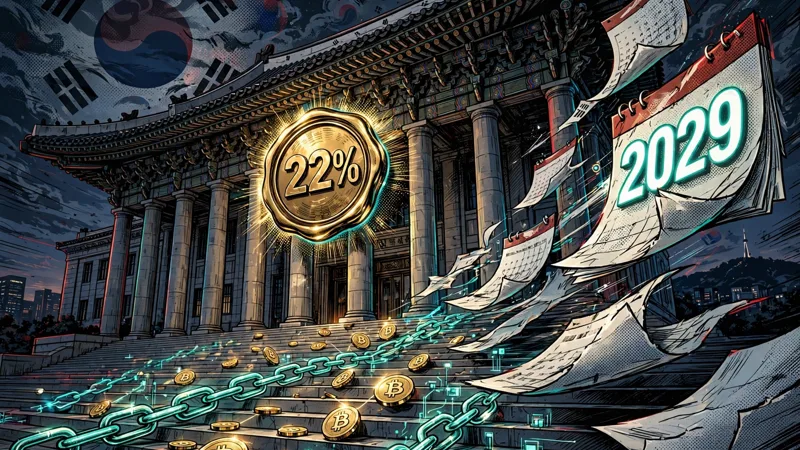
South Korea's government said on November 5, 2026, that it will seek a two-year delay of the planned tax on cryptocurrency gains, moving the start date from January 1, 2027 to 2029, the fourth postponement since the tax was legislated in 2020. Finance Minister Lee Hyoung-il announced the plan at a press conference in Seoul, saying the government will work with the National Assembly to amend the Income Tax Act. The government cited the start of virtual-asset information exchange with the United States in 2029 and the need to prepare the tax system, and it also plans a three-year loss carryforward so investors can offset future gains with past losses.

Bank of England Raises Rates to 4% in First Hike Since 2023, Warns Inflation Could Near 5%
The Bank of England raised Bank Rate by 0.25 percentage points to 4% on November 5, 2026, its first increase since August 2023, in an 8-1 vote of the Monetary Policy Committee. Catherine L Mann was the sole dissenter, voting for a larger 0.5 point rise to 4.25%. The Bank said UK inflation, at 3.5% in September, is now expected to rise to around 5% by the middle of 2027 before returning to its 2% target in the third quarter of 2028. Several committee members signalled further hikes are likely, though the Bank said policy is not on a pre-set path. Bitcoin ($BTC) traded near $80,100 after the decision, down about 3.7% in 24 hours, according to CoinGecko.