

South Korea Orders Emergency Checks of Crypto Exchanges After Binance Hack, Urges Bigger Cold Wallets
Published November 2, 2026, 12:45 PM PKT. Based on Reuters' November 2, 2026 wire report, MoneyToday's November 2, 2026 report on the Financial Services Commission meeting, TokenPost's November 2, 2026 report on cold wallet ratios, and KBS's November 2, 2026 report on the summoned exchanges.
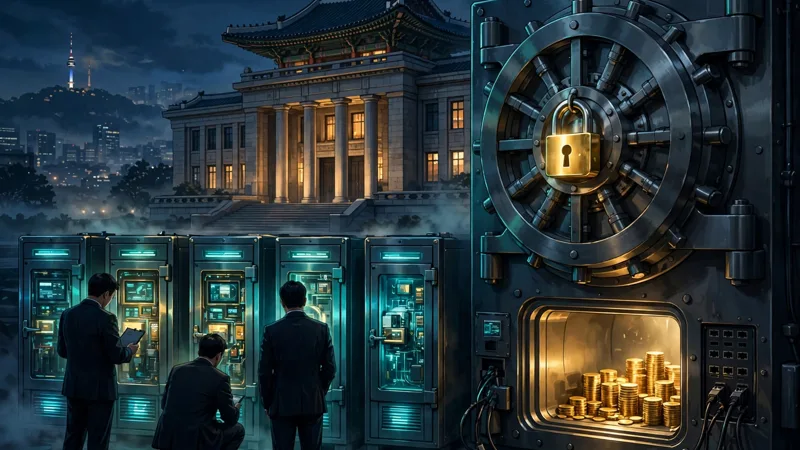
South Korea's financial regulator has ordered emergency checks of the country's crypto exchanges after the record theft from Binance, telling the industry to move more customer assets offline and harden the systems that approve withdrawals. The Financial Services Commission (FSC) held an emergency meeting on Monday, November 2, 2026, chaired by Digital Finance Policy Officer Yoo Young-jun, with the Financial Supervisory Service, the Korea Financial Security Institute, the Digital Asset Exchange Association (DAXA) and major virtual asset operators, according to MoneyToday. Reuters reported the same day that the regulator urged local exchanges to tighten security to prevent hacking attacks after the $6.3 billion theft at Binance last week. The meeting reviewed the impact of the Binance incident on the domestic market and the response systems of Korean operators, and it came with immediate instructions rather than a consultation: inspect hot wallets now, raise cold wallet ratios, and build up reserves.
The emergency inspection: hot wallets, approvals and admin access
The inspection targets the management of hot wallets, the internet-connected wallets exchanges use to process deposits and withdrawals, according to MoneyToday. The FSC focused on access controls for domestic operators' computer systems, on approval and signature systems for wallet withdrawals such as hot wallets, and on the management status of administrator privileges. The reason is the suspected route of the Binance attack itself: the primary cause was identified as the possibility of internal system access through employees' work laptops, MoneyToday reported, with the suggestion that unauthorized access to the transaction approval and signature system may have led to the withdrawal of virtual assets. A hot wallet carries a higher risk of external exposure precisely because it stays connected to the internet, unlike a cold wallet, which is isolated from it. The commission also urged immediate measures beyond the inspection itself, including continuous monitoring of deposits and withdrawals, securing additional response personnel, operating a rapid coordination system for reporting and sharing abnormal access attempts, and accumulating additional reserves.
The cold wallet numbers: Upbit above 99%, two exchanges just above 80%
South Korean law already requires exchanges to store more than 80% of users' virtual assets in cold wallets, with deposited funds held at banks, according to MoneyToday. The meeting put numbers on how far above that floor each major exchange sits. Upbit's cold wallet share exceeded 99%, Bithumb's was about 94%, and Coinone's was about 85%, according to TokenPost, while Digital X and Gopax were just above 80%, leaving all five named platforms at or above the legal threshold but the last two close to the minimum. KBS reported the same spread, from the low 80% range to 99%, and said plans to increase the proportion of assets stored in cold wallets were raised at the meeting. The FSC's push is therefore not about bringing exchanges up to the legal minimum, which they already meet, but about widening the safety margin above it. To prepare for incidents, operators are also required either to purchase insurance or mutual aid coverage, or to accumulate reserves of at least 3 billion won, based on the standard for won-denominated exchanges, according to MoneyToday.
What happens next: a full-sector security meeting on November 5
The exchange meeting is the first step in a wider review. The FSC is scheduled to hold a security inspection meeting for the entire financial sector on November 5, 2026, attended by the Financial Supervisory Service, the Financial Security Institute and the heads of the five major commercial banks, according to KBS. TokenPost placed the same meeting on Thursday, November 5, in South Korea. The FSC said it plans to keep strengthening its response system in close cooperation with relevant agencies and the industry to prevent additional security breaches and to stop the spread of damage, according to MoneyToday. The trigger was the October 29, 2026 theft of about $6.3 billion in virtual assets from Binance's hot wallet, which the U.S. Federal Bureau of Investigation has attributed to North Korea's TraderTraitor group. Binance has said it is tracking and freezing the stolen assets and that all user losses will be fully compensated with company funds, according to MoneyToday, and it has since restored phased withdrawals and reported about 95% replenishment of the affected assets. For South Korea, the timing also follows a domestic breach wave in October, including a personal data leak at Bithumb, which KBS noted in its report on the emergency meeting. No new Korean exchange hack, loss figure or enforcement penalty was announced at the November 2 meeting itself, and the commission has not published a new cold wallet ratio requirement, so the concrete outcome so far is the inspection order, the urged measures and the November 5 date.
This article is news reporting and is not investment advice.
Sources
- South Korea Financial Services Commission, emergency meeting, November 2, 2026 (primary source: the meeting, the emergency inspection order and the urged measures, as reported by MoneyToday and Reuters)
- MoneyToday, Regulator orders emergency checks of local exchanges after Binance hack, urges higher cold wallet ratios (November 2, 2026, secondary source: meeting chair Yoo Young-jun, attendees, inspection focus, urged measures, 80% cold wallet rule and 3 billion won reserve requirement)
- Reuters, via TradingView, South Korea urges cryptocurrency exchanges to tighten security (November 2, 2026, secondary source: regulator urging exchanges to tighten security after the $6.3 billion Binance theft)
- TokenPost, South Korea's FSC Reviews Exchange Security and 80% Cold-Wallet Rule (November 2, 2026, secondary source: Upbit above 99%, Bithumb about 94%, Coinone about 85%, Digital X and Gopax just above 80%, November 5 wider review)
- KBS News, November 2, 2026 (secondary source: FSC summoning Upbit, Bithumb and Coinone officials, cold wallet share spread from the low 80% range to 99%, November 5 full-sector meeting with the five major commercial banks)
MABOnChain Daily Brief
The key crypto and markets stories in one short, plain-language email. Free. Unsubscribe any time.
Prefer chat? Join us on Telegram Watch on YouTube
Keep reading
BTCPay Server Identifies Attack Vector in Older Versions After Bitcoin Hot Wallet Drains
BTCPay Server told operators to shut down their payment servers on November 1, 2026, after receiving reports that attackers were sweeping bitcoin from hot wallets on self-hosted installations. A November 2, 2026 incident-response update identified an attack vector targeting instances running version 2.4.1, released July 23, 2026, or older.

Akedo (AKE) Drops 32% as Trending Sell-Off Extends Slide From September Peak
Akedo (AKE) traded at about $0.0065 on November 2, 2026, down 32.22% in 24 hours and back on CoinGecko's trending list, according to CoinGecko trending data captured at 04:51 UTC.

Aave Freezes $136M tBTC Market as Threshold Halts Bitcoin Redemptions
Aave froze new deposits and borrowing against tBTC on its Ethereum V3 Core market at 10:01 UTC on October 31, 2026, after Threshold Network suspended tBTC minting and Bitcoin redemptions for security maintenance. The market held about 1,760 tBTC worth about $136.6 million at the time, roughly 42% of circulating tBTC.

Nvidia and Nike Join 50 Issuers Objecting to OKXICE Tokenized Shares
OKXICE's October 30, 2026 public notice lists 50 issuers that have filed Notices of Issuer Objection, up from 38 issuers on October 28 and 33 on October 27.